
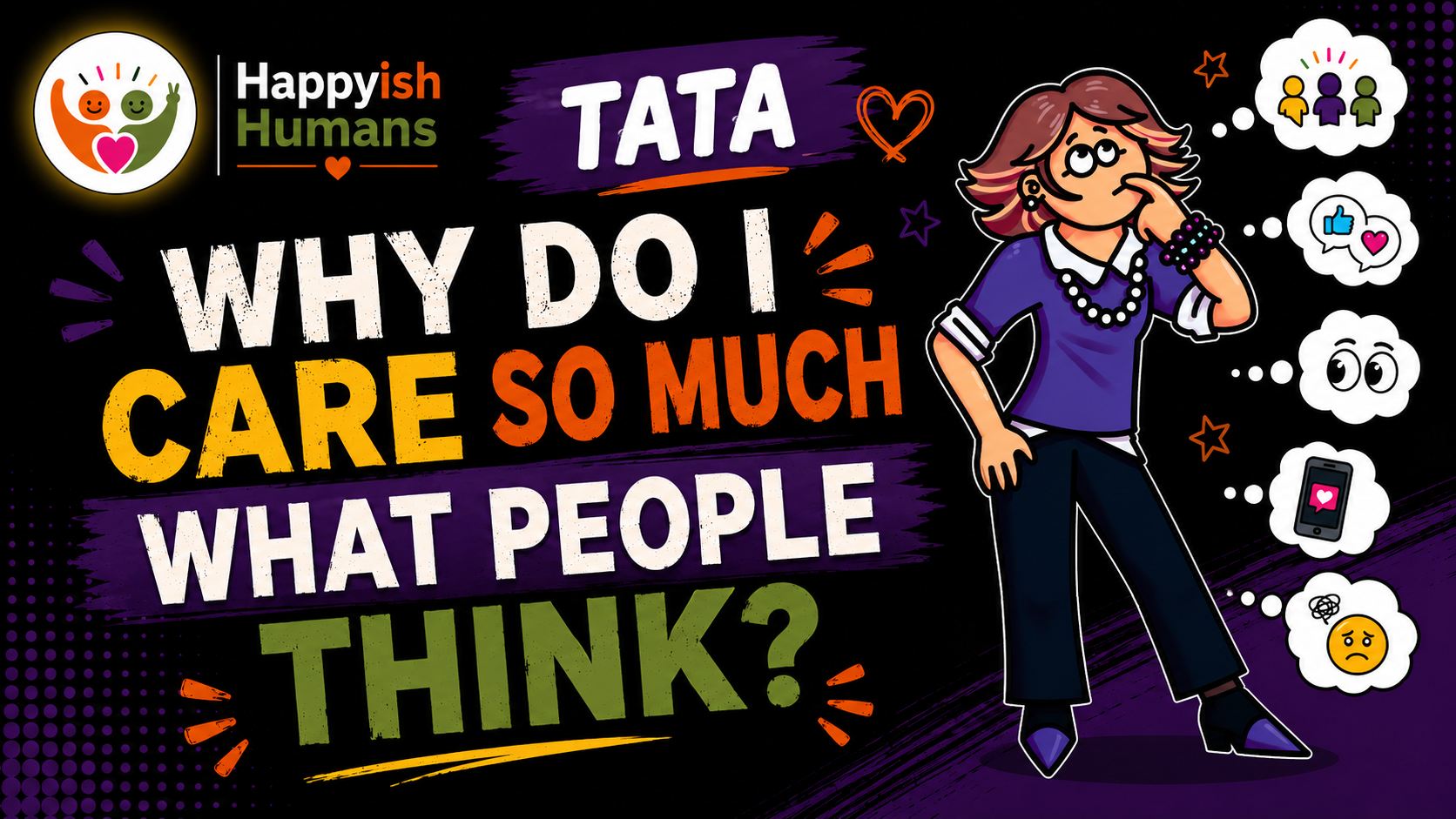
Today's question is "Why do I care so much about what people think?", sponsored by TATA, your Adaptation Voice, the part of you that's been quietly running a popularity poll in the background of your life since before you can remember.
It shows up before you hit send on a text, rereading it four times, wondering if it sounds too much, too little, too weird. It shows up in a room full of people, where instead of just being in the conversation, part of you is simultaneously monitoring it, how did that land, did I talk too much, does everyone still like me. It shows up as the replay after a totally normal social interaction, lying in bed at night, running back over one slightly awkward moment like it's evidence in a trial only you're attending.
You think this means you're insecure, or too dependent on approval, or that you just need to "care less what people think." You're not, and it's not that simple. It just means TATA has a job, and her job is checking your social standing constantly, because for most of human history, your social standing wasn't a nice-to-have. It was survival.
THE SCIENCE PART
Here's what's actually happening, and it's not vanity, it's a built-in gauge.
There's a concept called sociometer theory, and the idea is this: your self-esteem isn't really a standalone measure of how you feel about yourself in a vacuum. It's more like a gauge, constantly reading your level of social acceptance and feeding that reading back to you as a feeling. When the gauge reads "accepted, included, liked," you feel good about yourself. When it reads "excluded, judged, at risk of rejection," your self-esteem drops, fast, and TATA starts scanning for what went wrong.
Think of it like the fuel gauge in a car. The gauge itself doesn't create the fuel level, it just reads it and reports back, so you can act accordingly before you're stranded. Your self-esteem works the same way with social belonging: it's not vanity checking in, it's a survival gauge, constantly monitoring whether you're safely connected to the group or at risk of being cut off from it.
That gauge made total sense for most of human history, when being excluded from your group didn't just hurt your feelings, it could mean losing access to food, protection, and survival itself. So, your brain built a highly sensitive instrument for detecting social risk early, before the rejection actually happened, because catching it early gave you a chance to fix it. That instrument is still running today, checking constantly, even in situations where the actual stakes are a slightly awkward text message, not exile from the tribe.
THE CHILDHOOD PART
Nobody's born checking a social gauge this closely. That sensitivity gets calibrated, usually in an environment where belonging felt genuinely conditional, something you had to actively maintain rather than something you could just count on.
Maybe approval in your house depended on performance, grades, behavior, being easy to manage, so you learned early that being liked wasn't guaranteed, it was something you had to earn, continuously, with no permanent finish line. Maybe you experienced real social rejection at a formative age, being excluded, teased, or left out, and your gauge calibrated itself to scan harder afterward, so you'd never be blindsided by it again. Maybe your caregivers' moods were unpredictable, and reading the room accurately, whether they were pleased with you or not, felt directly tied to your safety, so the checking became constant, automatic, almost involuntary.
None of that was you being overly sensitive. That was a kid's nervous system doing exactly what it's designed to do, calibrating a survival gauge based on the actual evidence available, that belonging was conditional and worth monitoring closely. In that environment, the vigilance was accurate. It kept you safer, more prepared, less likely to be caught off guard.
The problem is the gauge never got recalibrated for a life where belonging is generally more stable now. It just kept running the same sensitivity setting, checking constantly, treating a slightly awkward text or a quiet room the same way it once treated genuine risk of exclusion, because the gauge doesn't know the difference between then and now unless something teaches it.
THE GO-TO OPTIONS
When the caring gets overwhelming, you usually do one of two things.
Option one: you let the gauge run the whole show. Every interaction gets analyzed, replayed, adjusted for, and your actual choices, what you say, wear, do, start bending around what you predict will keep the gauge reading "accepted." This feels like being considerate. It's actually just outsourcing your decisions to a survival instrument that was calibrated for a much higher-stakes environment than the one you're actually in.
Option two: you try to force yourself not to care at all, telling yourself "other people's opinions don't matter," without ever actually addressing why the gauge is so sensitive in the first place. This sounds strong. It doesn't work for long, because you haven't recalibrated anything, you've just tried to silence an alarm that's still wired the same way, and it comes right back the next time the stakes feel high.
Neither one questions whether the gauge's current sensitivity setting actually matches your current life. One obeys the gauge completely. The other just tells it to be quiet, which it never actually listens to.
THE HAPPYISH HUMANS SHIFT
There's a third option, and it starts with recalibrating the gauge instead of obeying it or silencing it.
Name who's talking and what it is that you're feeling. "This is TATA. She's checking the social gauge again." Then name the actual feeling underneath the checking, not the situation, the feeling: exposed, at risk of rejection, unsure of my standing. Naming the feeling itself, out loud or on paper, is called affect labeling; in plainer terms, name it to tame it. It calms the brain's alarm system enough that you can actually examine what's driving the checking instead of just getting swept along by it. So, the full move is: "This is TATA, and what I'm actually feeling is ___." Not the worry about what they think. The feeling underneath needing to know.
Reframe the question. Swap "Why do I care so much about what people think?" for:
"What is the gauge actually protecting me from right now?"
"Is my belonging in this relationship actually conditional, or does it just feel that way?"
"What would I do here if the gauge weren't running at all?"
"Why do I care so much what people think" keeps you stuck defending or judging the caring itself. These questions get you underneath it, to what the gauge thinks is actually at stake.
Check the evidence. Separate the gauge's alarm from the actual risk:
Gauge reading: "They might think less of me. I might be judged, excluded, disliked."
Actual evidence: "Is there real evidence of rejection here, or is the gauge just running its default high-alert setting?"
Then ask directly: "If this exact interaction happened and nobody noticed or cared, would that actually threaten anything real in my life?" Most of the time, the honest answer is no, the stakes the gauge is treating as urgent are nowhere near the survival-level stakes it was calibrated for. The gap between what the gauge is reacting to and what's actually at risk is usually enormous.
Find the silver lining, use positive words or affirmations, or reframe the story. Not toxic positivity, just a wider lens. "Caring what people think kept me safe once; it doesn't mean every reading is accurate now." Or: "I can value connection without treating every interaction like a referendum on my worth." You're not pretending belonging doesn't matter. You're just refusing to let a hypersensitive gauge make every decision for you.
Pick some tiny actions.
Let one small thing go unaddressed, an unanswered "did that sound weird" question, and notice what actually happens.
Ask yourself who in your life has already proven their acceptance of you isn't conditional, and lean on that evidence.
Write down the actual worst-case outcome of the current worry, then ask how survivable it really is.
Practice one small act that isn't optimized for approval, wear the thing, say the honest thing, and notice you're still okay.
Brainstorm about how you can improve your social safety and build closer relationship (text an old friend, call a relative just to say hi, join a club- but not the “Bricks Have Feelings” club- long story!).
Say it out loud: "My worth isn't a live vote. It's already settled."
WHY THE SMALL STUFF WORKS
A hypersensitive gauge recalibrates through repeated, low-stakes proof that you are socially safe, not through a single decision to "care less." Every time you let something go unmanaged and nothing actually falls apart, your brain quietly logs that data, and the gauge's sensitivity setting drifts a little closer to accurate. You can't argue TATA out of caring what people think. You have to slowly show her, in small doses, that the stakes aren't what she thinks they are.
You don't need to stop caring about people entirely. You need enough small proof that your belonging isn't actually as conditional as the gauge keeps insisting.
FINAL NOTE
Nothing is wrong with you for caring what people think. Your brain built a survival gauge for social belonging because, for most of human history, belonging really was survival, and TATA's still running that same gauge today, even in a life where the stakes are usually much smaller than she thinks. You're not insecure. You're not too sensitive. You're just carrying an instrument that's overdue for a little recalibration.
You got this! Nobody is coming to save you… you have to save yourself!
INSPIRATION:
“Care about what other people think and you will always be their prisoner.” — Lao Tzu