
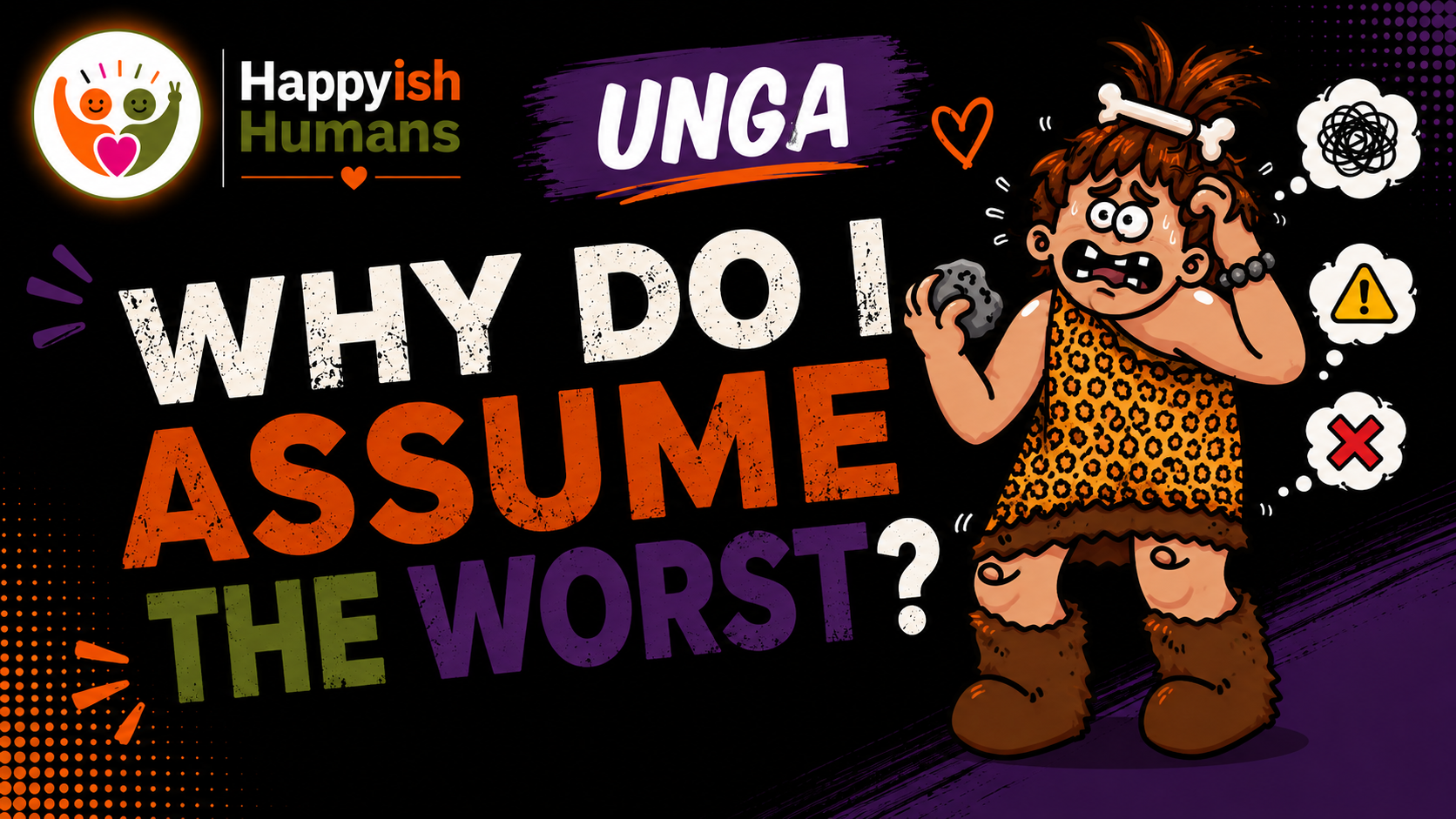
Today's question is "Why do I assume the worst?", sponsored by UNGA, your Survival Voice, the part of you that would rather brace for a disaster that never comes than get caught off guard by one that does.
It shows up the second your phone buzzes with "hey, can we talk," and before you've even opened the message, your whole body has already decided this is bad news. It shows up when a doctor's office calls, and your mind jumps straight to the worst possible diagnosis before you've even answered, heart pounding for a conversation that hasn't happened yet. It shows up when someone's late, and instead of "traffic," your brain goes straight to the worst-case scenario, fast, vivid, and fully formed, before there's any actual evidence either way.
You think this means you're pessimistic, or dramatic, or that you just can't relax and trust things will be fine. You're not, and it's not that simple. It just means UNGA has decided that predicting disaster in advance is safer than being surprised by one, and she's not wrong that it feels safer. It's just exhausting to live in.
THE SCIENCE PART
Here's what's actually happening, and it's not pessimism, it's an old survival calculation.
Think about it from an evolutionary angle for a second. If your ancestor heard a rustle in the grass and assumed it was nothing, and it turned out to be a predator, that mistake could be fatal. If your ancestor heard the same rustle, assumed the worst, and it turned out to be just the wind, the cost of being wrong was basically nothing, a little wasted adrenaline. Over generations, brains that defaulted to "assume danger first" survived more often than brains that defaulted to "assume it's probably fine." That's not a flaw. That's the winning strategy, biologically speaking, and you inherited it.
The mechanism doing this work is your amygdala, running a cost-benefit calculation that isn't actually about accuracy, it's about safety margins. Assuming the worst costs you a little stress now. Assuming the best and being wrong could, theoretically, cost you everything. So, your brain, doing exactly what it evolved to do, consistently rounds toward the scarier option, because false alarms are cheap and missed threats are expensive.
Chronic hypervigilance just means that calculation got stuck running at a higher setting than your actual life requires. You're not in the grass anymore. Most rustles really are just wind. But the system doing the calculating hasn't been told that yet, so it keeps rounding toward disaster, every single time, just in case.
THE CHILDHOOD PART
Nobody's born assuming the worst by default. That setting gets calibrated, usually in an environment where assuming the worst turned out to be the more accurate bet more often than not.
Maybe you grew up somewhere bad news actually did show up unpredictably, so bracing for it in advance felt like the only way to soften the blow when it came. Maybe you learned that good moments were often followed by bad ones, so relaxing into something good started to feel dangerous, like letting your guard down right before it mattered most. Maybe you were the one who had to notice trouble early, a mood shift, a tension in the room, before anyone else clocked it, because catching it early gave you a few extra seconds to prepare.
None of that was you being negative. That was a kid's nervous system doing an accurate read of an unpredictable environment, and adapting the only way it knew how: assume the worst first, so you're never caught flat-footed by it. In that environment, that strategy worked. It kept you a step ahead.
The problem is the calibration never got updated for your life now. Your environment may be calmer, safer, more stable, but UNGA doesn't know that automatically, she just knows the setting she was trained on. So, a phone call, a delay, an ambiguous text, still gets run through the same old filter: assume danger, prepare for the worst, don't get caught off guard again.
THE GO-TO OPTIONS
When the worst-case thinking kicks in, you usually do one of two things.
Option one: you follow it all the way down. You spiral through every possible bad outcome, mentally rehearsing the disaster, sometimes even preparing your reaction to news that hasn't happened yet. This feels like being prepared. It's actually just handing UNGA the wheel and letting her drive you through a crisis that, most of the time, isn't actually happening.
Option two: you try to force yourself to "just think positive," slapping an affirmation on top of the fear without ever addressing why UNGA thinks disaster is the safer bet to assume. This sounds healthier, but it doesn't stick, because you haven't actually shown her any evidence, you've just told her to be quiet, which she's never once listened to.
Neither one questions whether the worst-case really is the most likely case, right now, in this specific situation. One rides the alarm all the way down. The other just paints over it.
THE HAPPYISH HUMANS SHIFT
There's a third option, and it starts with checking whether the worst-case is actually the likely case, or just the loudest one.
Name who's talking and what it is that you're feeling. "This is UNGA. She's already bracing for the worst." Then name the actual sensation underneath the assumption, not the disaster story, the feeling: tight, on edge, braced, tense, pessimistic, afraid. Naming the feeling itself, out loud or on paper, is called affect labeling; in plainer terms, name it to tame it. It measurably calms your brain's alarm system, which matters here because UNGA operates in the body first, thoughts second. So, the full move is: "This is UNGA, and what I'm feeling is ___." Not the catastrophe. The sensation driving it.
Reframe the question. Swap "Why do I assume the worst?" for:
"Is there actual evidence for this outcome, or just an old habit of bracing?"
"What are three other things this could realistically mean?"
"What would I tell a friend who was assuming this exact worst-case?"
"Why do I assume the worst" keeps you stuck defending the habit. These questions get you underneath it, to whether this specific worst-case actually holds up.
Check the evidence. Separate the assumption from the actual likelihood:
Assumption: "This is definitely bad news."
Actual evidence available: "What do I actually know right now, versus what am I filling in?"
Then ask: "Out of all the times I've assumed the worst before, how often was I actually right?" Most of the time, when you actually track it, the worst-case shows up far less often than UNGA predicted, she's just louder and faster than the more boring, more likely outcomes, so she gets there first and convinces you she's the only option on the table.
Find the silver lining, use positive words or affirmations, or reframe the story. Not toxic positivity, just a wider lens. "Assuming the worst kept someone safe once; it doesn't mean it's accurate now." Or: "I've survived being wrong about the worst-case plenty of times before." You're not forcing false optimism. You're just refusing to treat UNGA's first guess as the only possible outcome.
Pick some tiny actions.
Write down the worst-case, then write down two more realistic possibilities next to it.
Wait five minutes before reacting to ambiguous news, texts, or silence.
Ask yourself what evidence you'd need to actually confirm the worst-case, then check if you have it.
Do something physical, a short walk, some stretching, to help the adrenaline move through instead of just circling in your head.
Say out loud: "This is a guess, not a fact."
WHY THE SMALL STUFF WORKS
UNGA calms down through evidence that she is safe, not arguments, so the fastest way to loosen her grip is proof, collected in small, repeated doses, that the worst-case doesn't show up nearly as often as she predicts. Every time you track an assumed disaster and it turns out to be nothing, your brain quietly logs that data, and over time, the alarm gets a little less trigger-happy. You're not trying to convince her the world is safe in one conversation. You're slowly updating her calibration, one tracked prediction at a time.
You don't need to become an optimist overnight. You just need enough small proof that the rustle in the grass is, usually, just the wind.
FINAL NOTE
Nothing is wrong with you for assuming the worst. Your nervous system learned, somewhere along the way, that predicting disaster in advance was safer than being blindsided by it, and she's still running that calculation today, even in a life that mostly doesn't require it anymore. You're not pessimistic. You're not broken. You're just carrying a threat-detection system that's overdue for some updated data.
You got this! Nobody is coming to save you… you have to save yourself!
INSPIRATION:
"Worry does not empty tomorrow of its sorrow; it empties today of its strength." —Corrie ten Boom, The Hiding Place