
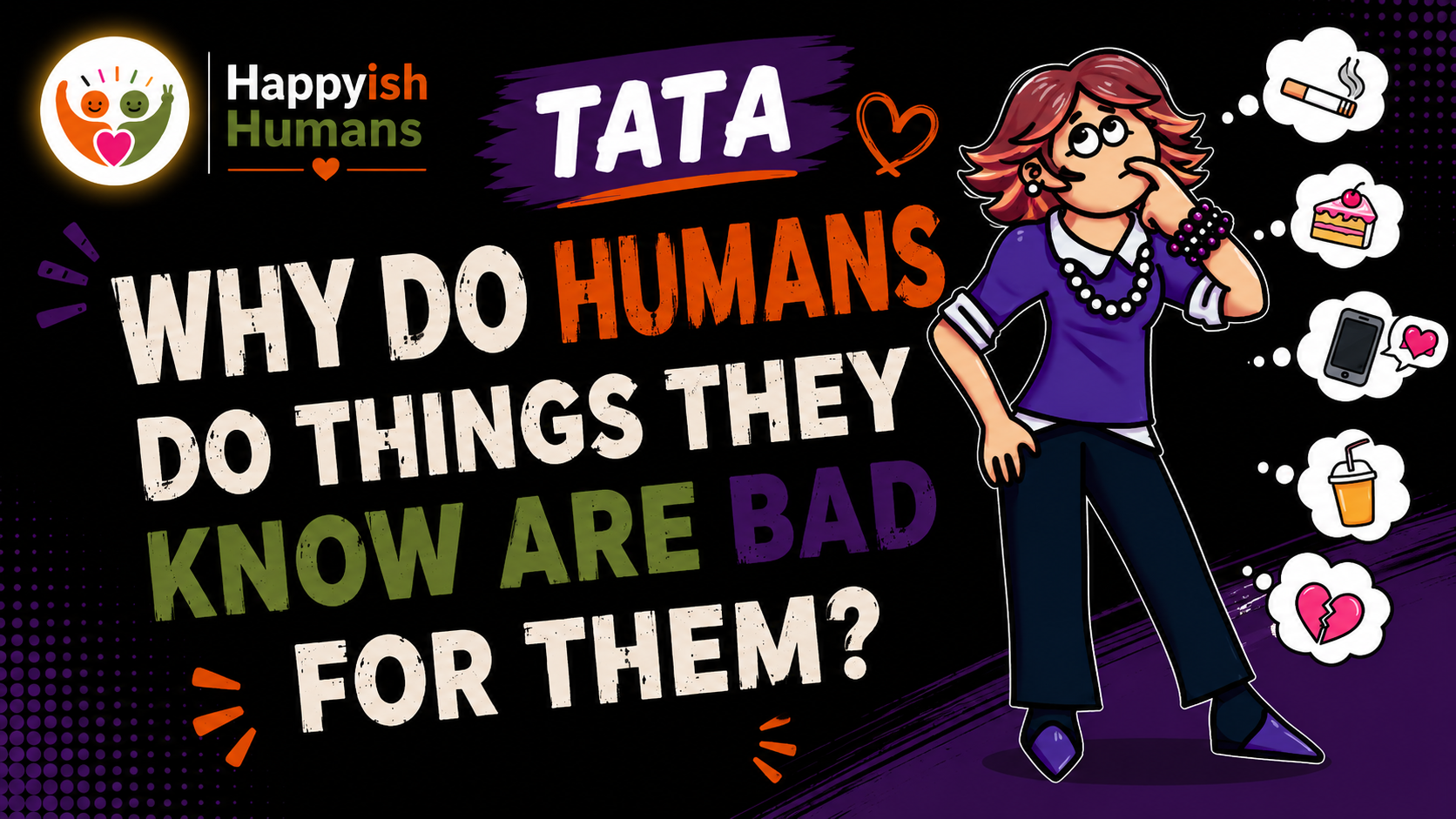
Today's question is "Why do humans do things they know are bad for them?", sponsored by TATA, your Adaptation Voice, the part of you that doesn't just notice you're about to repeat the pattern, she writes you a very convincing reason why this time is different.
It shows up when you know exactly how the story ends with a certain person, and you reach out anyway, telling yourself "but this time feels different." It shows up when you order the thing you know will make you feel awful after, and somewhere between deciding and doing it, TATA's already built a whole justification: you deserve it, it's been a hard week, one time won't matter. It shows up when you find yourself back in a familiar dynamic, a familiar job, a familiar type of relationship, that's hurt you before, and you're standing there thinking, "how did I end up here again," except some part of you built the on-ramp yourself, one small, reasonable-sounding justification at a time.
You think this means you're weak-willed, or self-sabotaging, or that you just don't learn. You're not, and you do. It just means TATA has a job, and her job isn't protecting you from the bad decision. It's making the bad decision feel coherent enough to actually go through with.
THE SCIENCE PART
Here's what's actually happening, and it's not a lack of self-control, it's a mismatch between two systems that are supposed to work together, but don't.
You have a part of you that's drawn back to familiar patterns, even harmful ones, because familiar reads as safe to your nervous system, regardless of whether it's actually good for you. That's the pull. But pulling toward something you already know is bad for you creates a problem: it doesn't match the story you have about yourself as a reasonable, self-respecting person. That mismatch has a name, cognitive dissonance, the uncomfortable tension of holding two things that don't fit together: "I know this is bad for me" and "I'm about to do it anyway."
TATA's whole job is meaning-making, and dissonance is exactly the kind of discomfort she rushes in to resolve by overthinking. She doesn't resolve it by stopping the behavior. She resolves it by rewriting the story so the behavior makes sense: "this time is different," "I've changed," "it's just this once," "I deserve this." Think of her like a lawyer who's already decided the verdict and is now just building the closing argument to match it. She's not lying to you, exactly. She genuinely believes the case she's building, because building it is the only way to make the tension go away.
That's why the behavior repeats even when you "know better." Knowing better lives in one part of your brain. The story TATA tells to resolve the discomfort of repeating the pattern anyway lives somewhere else, and her story is the one that's actually driving the car.
THE CHILDHOOD PART
Nobody's born needing a justification to return to something familiar and harmful. That skill, and it is a skill, gets built somewhere specific, usually a childhood environment where the familiar and the harmful were tangled together from the start.
Maybe love and hurt showed up from the same source, the same person who comforted you also caused the pain, so your nervous system learned early that going back to the source of both was just what closeness looked like, there wasn't a version of love that didn't also include some risk of hurt. Maybe you learned to explain away things that didn't make sense, "they were just stressed," "they didn't mean it," because making sense of the confusing thing felt safer than sitting in the confusion, and that meaning-making muscle got a lot of practice, early and often. Maybe returning to a difficult situation wasn't actually optional, you were a kid, you couldn't leave, so your mind built a story that made staying feel like a choice instead of a requirement, because choosing it felt less powerless than being stuck with it.
None of that was you being naive. That was a kid building a coping mechanism that let her tolerate an environment she couldn't actually leave, by constructing a story that made the return, to the person, the pattern, the dynamic, feel survivable, even reasonable.
The problem is that meaning-making machinery didn't come with an off-switch once you actually could leave. It just kept running the same program: encounter something familiar and harmful, feel the pull, resolve the dissonance with a justification, go back in. So now, as an adult, with real options available, TATA's still writing the same closing argument she wrote as a kid, except now there's no locked door keeping you there, just the story convincing you to walk back through it voluntarily.
THE GO-TO OPTIONS
So, when you catch yourself repeating a pattern you know is bad for you, you usually do one of two things.
Option one: you accept TATA's story completely. "This time is different" becomes fact instead of hypothesis, and you go all in on the justification without ever checking it against your actual track record. This feels like hope. It's actually just cognitive dissonance getting resolved in the direction that lets the behavior continue.
Option two: you catch yourself doing it and immediately spiral into self-blame, "I'm so stupid, I always do this," without ever examining why the pattern feels so pulling in the first place. This feels like accountability. It's actually just shame stacked on top of an unexamined pattern, and shame has never once been shown to stop a compulsion, it just makes the next round of self-forgiveness harder to access.
Neither one questions where the story TATA's telling actually came from. One believes the justification. The other just punishes you for having needed one.
THE HAPPYISH HUMANS SHIFT
There's a third option, and it starts with catching TATA's story before you act on it, not after.
Name who's talking and what it is that you're feeling. "This is TATA. She's building the case for why this time is different." Then name the actual feeling underneath the pull, not the justification, the feeling: lonely, restless, anxious, craving relief. Naming the feeling itself, out loud or on paper, is called affect labeling; in plainer terms, name it to tame it. It calms the brain's alarm system enough that you can actually look at the pattern instead of just getting swept into the story that resolves it. So, the full move is: "This is TATA, and what I'm actually feeling is ___." Not the justification. The feeling the justification is covering for.
Reframe the question. Swap "Why do I keep doing things I know are bad for me?" for:
"What discomfort is TATA trying to resolve with this story?"
"What actually happened the last few times I told myself 'this time is different'?"
"What would I need to be true for this to genuinely be different this time, and is any of that actually present?"
"Why do I keep doing things I know are bad for me" keeps you stuck in shame about the pattern. These questions get you underneath it, to the story making the pattern feel justified in the moment.
Check the evidence. Separate the justification from the actual track record:
TATA's story: "This time is different. It'll be fine. I've changed, or they have."
Actual evidence: "What happened the last three times I believed this exact story?"
Then ask directly: "Is there new information here, or is this the same story with new packaging?" Most of the time, when you actually lay the pattern out, the "this time is different" story has shown up before, verbatim, right before the same outcome. TATA isn't lying on purpose. She's just resolving discomfort with the fastest available story, and the fastest available story is usually a repeat, not a revision.
Find the silver lining, use positive words or affirmations, or reframe the story. Not toxic positivity, just a wider lens. "Wanting relief isn't a character flaw, it's human, the question is just where I get it from." Or: "I can notice this pattern earlier every time I practice catching it, that's real progress, even if it's not instant." You're not shaming the pull. You're just refusing to let the story resolve the discomfort in the same direction every time.
Pick some tiny actions.
Write down "this time is different" and then honestly list what happened the last time you told yourself that exact thing.
Build in a mandatory pause, even ten minutes, between the urge and the action.
Call or text someone who can reality-check the story before you act on it.
Name the discomfort you're actually trying to resolve, and ask if there's a version of relief that doesn't cost you later.
Say it out loud: "This story feels true because it resolves discomfort, not because it's accurate."
WHY THE SMALL STUFF WORKS
Cognitive dissonance gets resolved fastest by the nearest available story, so the fastest way to interrupt the pattern is slowing down the gap between the urge and the justification long enough to actually check the story against reality. A ten-minute pause doesn't rely on willpower, it relies on giving your brain enough time to notice the discomfort without immediately papering over it with a familiar excuse. Once you can see the story clearly, it loses some of its grip, because stories work best when they go unexamined.
You don't need to win the fight against the pull every single time. You need enough small pauses to actually see the story TATA's telling before you act on it.
FINAL NOTE
Nothing is wrong with you for repeating a pattern you know isn't good for you. Your brain built a very efficient system for resolving the discomfort of doing something you "know better" than to do, and TATA's still running that system, closing arguments and all, every time the old pull shows back up. You're not weak. You're not broken. You're just working from a script that's overdue for a rewrite, and you're allowed to start rewriting it, one caught story at a time.
You got this! Nobody is coming to save you… you have to save yourself!
INSPIRATION:
"We do not learn from experience... we learn from reflecting on experience." —John Dewey