
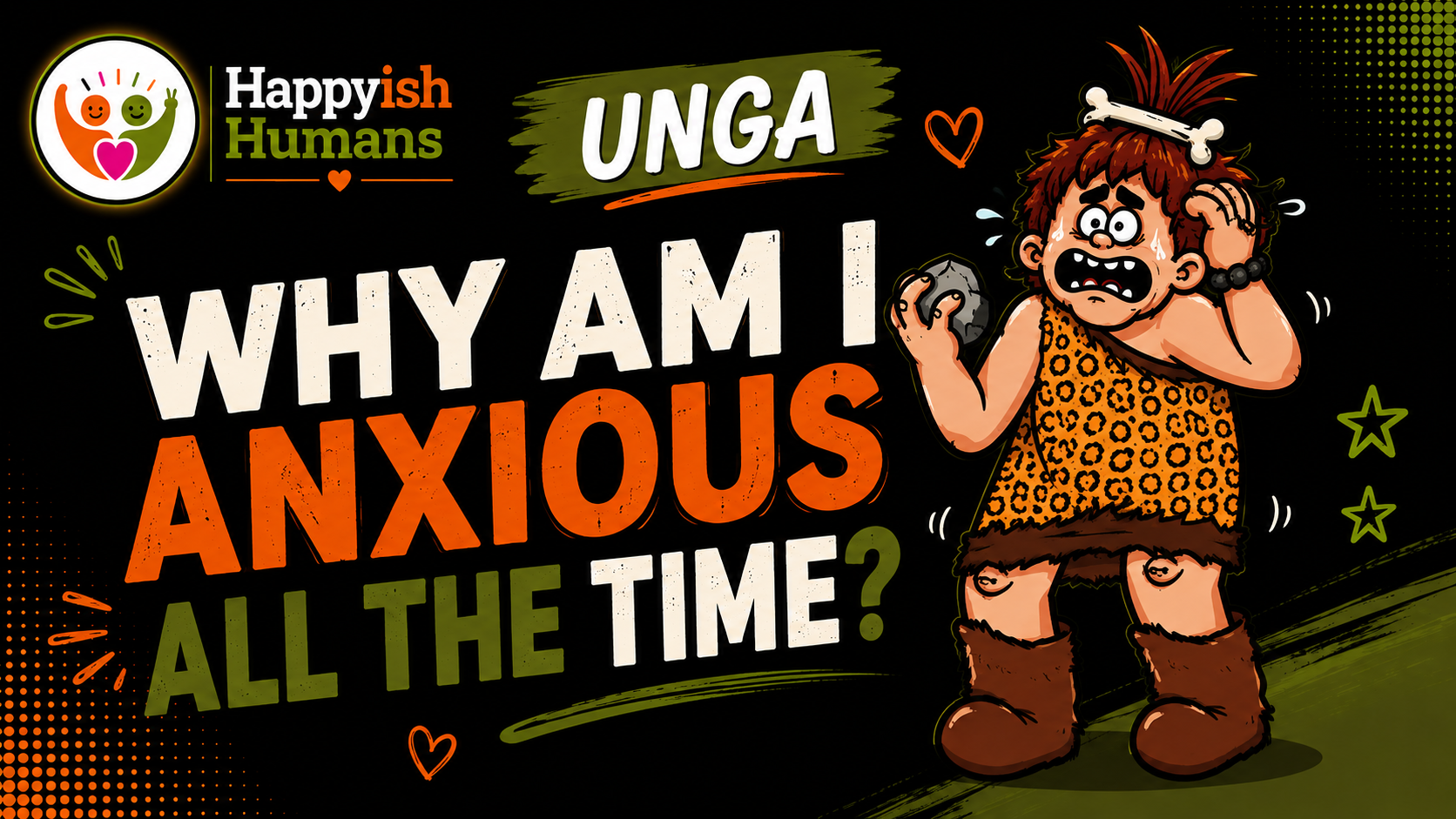
Today's question is "Why am I anxious all the time?", sponsored by UNGA, your Survival Voice, the part of you that installed a security system a long time ago and never got around to adjusting the settings.
It shows up while you're waiting on a text back, your chest tightening before you've even had a conscious thought about what the silence might mean. It shows up in a completely normal meeting, nothing wrong, nobody upset, and your leg won't stop bouncing under the table like it knows something you don't. It shows up at 1am, lying in bed with nothing specific to worry about, and your body decides to worry anyway, wide awake, heart going, for a reason you can't actually name.
You think this means something is wrong with you, that you're "too anxious," or too much, or built wrong somehow. You're not. It just means UNGA is doing exactly what she was trained to do: stay on alert, just in case. She's not broken. Nobody's ever told her the coast is clear.
THE SCIENCE PART
Here's what's actually happening, and it's not a character flaw, it's a setting.
Think of UNGA as a home security system. A good one is supposed to go off when there's an actual break-in; that's the whole point of having it. But some security systems get calibrated too sensitive, and they start going off for the mail carrier, a gust of wind, a moth near the window. The alarm sounds exactly the same whether it's a burglar or a breeze, because the system's job isn't to be accurate, it's to be fast.
That's your amygdala, the part of your brain running UNGA's operation. It's built to detect threat before your conscious mind even has a chance to weigh in, because in an actual emergency, thinking first would get you killed. So it reacts, then thinks, not the other way around. Racing heart, tight chest, restless legs, that clenched feeling in your stomach, that's the alarm going off before you've had a single thought about what set it off.
Hypervigilance is one of those words that sounds clinical, but the experience is painfully familiar. It’s the feeling of being “on” even when nothing is happening. It’s the constant scanning, the checking, the bracing, and the sense that something might go wrong, so your body stays ready just in case. Most people think it means they’re anxious or dramatic. It doesn’t. It’s older than that, older than language, older than childhood, older than memory.
Chronic hypervigilance just means the sensitivity got turned up and left there. Your baseline stress hormones, cortisol and adrenaline, sit a little higher than they need to, all day, so you're not reacting to danger, you're reacting from a system that's already halfway triggered before anything even happens. It's exhausting, because you're not just responding to today. You're running a security system stuck on high alert with nothing left to guard.
THE CHILDHOOD PART
Kids don't get to choose their environment; they just calibrate to it.
Maybe you grew up somewhere you had to read the room the second you walked in, gauge the mood before you said a single word, because getting it wrong had real consequences. Maybe the ground kept shifting, one day fine, one day not, and you learned that staying alert was the only way to catch the shift before it caught you. Maybe there wasn't one big danger, just a low hum of never quite knowing what you'd be walking into, and your nervous system did what nervous systems do: it adapted, and it adapted by staying switched on.
That's not you being "wired wrong." That's a smart kid's body doing exactly what it was supposed to do, tuning itself to a high sensitivity setting because in that environment, high sensitivity kept her safer. Missing a real threat was expensive. A few false alarms were not.
The problem is the setting never got recalibrated. Your life may be safer now, quieter, more predictable, but the system doesn't know that automatically; it just knows the setting it was left on. So here you are, in a room with no actual danger in it, and UNGA is still running the exact program she was trained to run: stay alert, just in case, always.
THE GO-TO OPTIONS
So, when the anxiety shows up with nothing obvious to point to, you usually do one of two things.
Option one: you believe the alarm, fully, every time. If UNGA's going off, something must actually be wrong, so you scan harder, double-check the thing you already checked, replay the conversation, avoid the situation altogether just to be safe. This feels responsible. It's actually just handing the wheel to a smoke detector that can't tell the difference between toast and a house fire.
Option two: you push through it, numb it out, over-caffeinate your way past the exhaustion, tell yourself you're "fine" while your shoulders live somewhere up near your ears. This works for about as long as ignoring a smoke detector works, which is to say, it doesn't stop the alarm, it just makes it harder to hear anything else.
Neither one turns down the sensitivity. One obeys the alarm. The other just mutes it and hopes.
THE HAPPYISH HUMANS SHIFT
There's a third option, and it starts with talking to the alarm system directly instead of either obeying it or ignoring it.
Name who's talking and what it is that you're feeling. "This is UNGA. My chest is tight and my heart is racing." Naming the physical sensation matters here almost more than naming the voice, because UNGA doesn't operate in thoughts, she operates in body signals; racing heart, shallow breath, restless hands. Putting a word on the sensation itself, "tight," "racing," "on edge," gives your prefrontal cortex something to do besides panic alongside her. This is what researchers call affect labeling, or, in plainer terms, name it to tame it: the simple act of naming the feeling measurably quiets the alarm center down. So, the full move is: "This is UNGA, and what I'm feeling is ___." Not the story about why. Just the feeling, named.
Reframe the question. Swap "Why am I anxious all the time?" for:
"What is UNGA actually scanning for right now?"
"Is there a real threat in this room, or just an alarm that fired first?"
"What would help my body feel safe in this exact moment?"
"Why am I anxious all the time" keeps you stuck arguing with the alarm. These questions get you underneath it, to what the system's actually reacting to.
Check the evidence. Separate the sensation from the story about danger:
Sensation: "My chest is tight, my heart is fast."
Story UNGA is telling: "Something is wrong. This is an emergency."
Then ask the only question that actually matters here: "Is there a real, present threat, right now, in this room?" Most of the time, the honest answer is no; the alarm fired, but nothing's actually on fire. That gap, between the sensation and the actual danger, is the whole ballgame.
Find the silver lining, use positive words or affirmations, or reframe the story. Not toxic positivity, just a wider lens. "This system kept me safe once; it's just overcalibrated now, not malfunctioning." Or: "I've felt this exact feeling before and I'm still here." You're not arguing the alarm away. You're just refusing to treat every alarm as proof of fire.
Pick some tiny actions.
Run your hands under cold water for thirty seconds.
Put both feet flat on the floor and actually notice the floor.
Breathe in for four counts, hold for four, out for six.
Name five things you can physically see around you, right now.
Say out loud: "The alarm went off. That doesn't mean there's a fire."
WHY THE SMALL STUFF WORKS
UNGA doesn't take instructions from your thoughts; she takes them from your body, so the fastest way to reach her is physical, not verbal. Cold water, slow breath, feet on the ground, these send a direct signal to your nervous system, specifically through something called the vagus nerve, that you are safe right now, in this body, in this room. You can't out-argue an alarm system with logic. You have to show it proof it can actually feel.
Small, boring, physical actions work because they speak UNGA's native language. You can process the "why" later, once the alarm's actually stopped ringing.
FINAL NOTE
Nothing is wrong with you for feeling anxious without an obvious reason. Your nervous system built an alarm system to keep you safe, and it's still doing its job, it just never got the memo that the emergency ended. You're not broken, and you're not "too much." You're just carrying a security system that's overdue for a recalibration.
You got this! Nobody is coming to save you… you have to save yourself!
INSPIRATION:
"Nothing diminishes anxiety faster than action." —Walter Anderson, The Confidence Course