
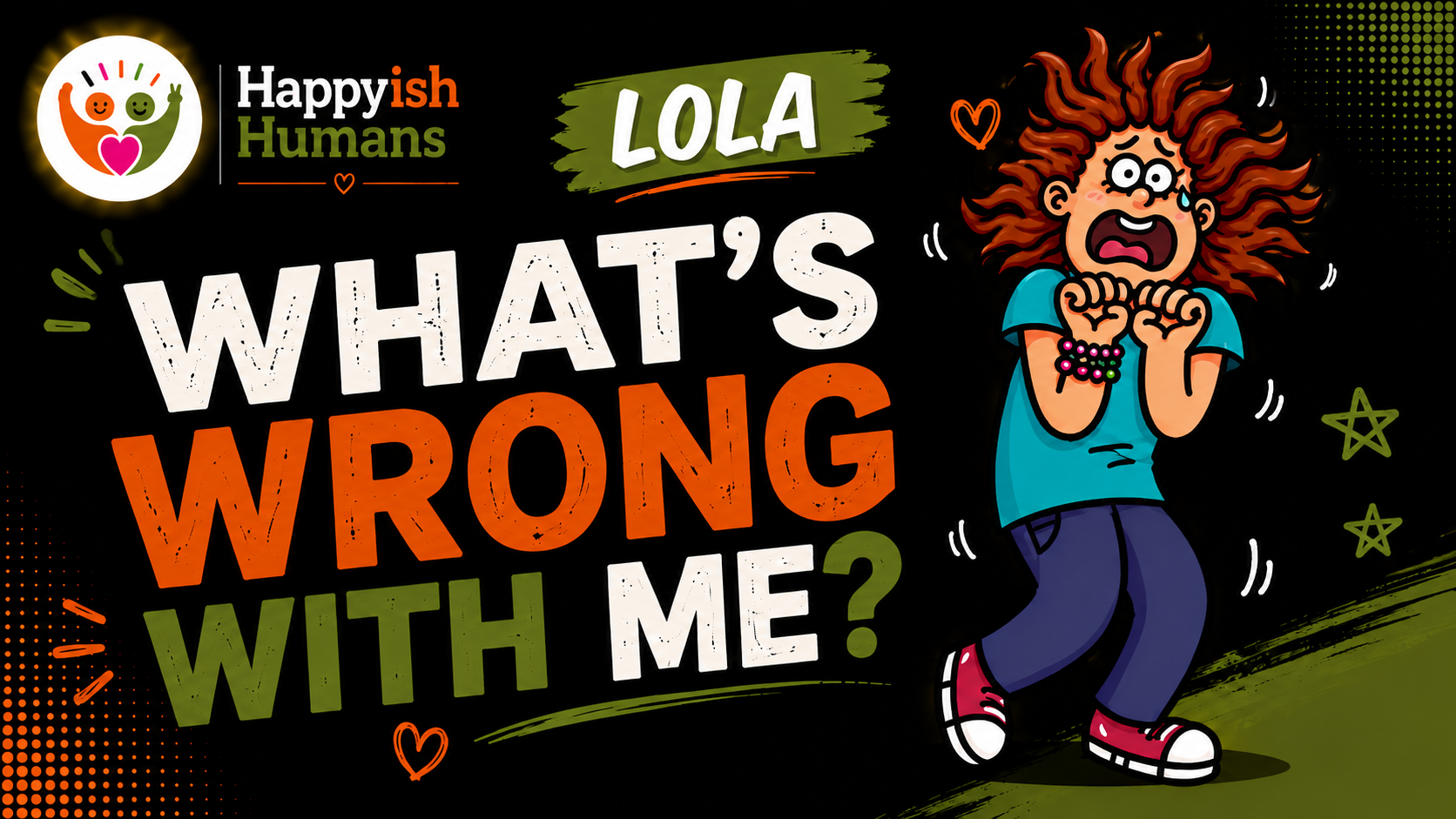
Today's question is "What's wrong with me?", sponsored by LOLA, your Trauma Voice, the part of you that started guarding your feelings before you even had words for them.
It shows up at 2am, replaying every time you were "too much." It shows up when your shirt snags on a door handle, making you spill your coffee and you briefly consider quitting your job. It shows up when the grocery bag splits in the driveway and you just want to sit on the ground and cry. And it shows up in the moments that actually matter, when you react bigger than you meant to, go quiet mid-conversation, or feel wrecked by something everyone else seems to shrug off.
You think this question means you're broken. You're not. It means LOLA is talking.
LOLA learned her job early: scan for danger, brace for criticism, take up less space, doubt your worth, and she used these as survival skills, not overreactions. She's still running the same playbook today, even though the danger that trained her is long gone. Old software, new problem.
THE SCIENCE PART
Here's what's actually happening. Your brain stores two different kinds of memory. There's the kind you can talk about, like your first day of school, your last birthday, what you had for lunch. That's explicit memory, and it comes with a timestamp. You know it happened then, not now.
Then there's implicit memory, which is the kind that doesn't come with a timestamp at all. It's stored as a feeling, a body sensation, a cringe. You don't "remember" it the way you remember a birthday. You just suddenly feel it, in the present tense, with zero warning. A tone of voice, a silence that goes on too long, someone's back turned toward you, and you're not thinking about the past. You're feeling like you're back in it, right now, no time-stamp attached.
That's LOLA's whole territory. She's not overreacting to today. She's reacting to something that resembles today, but actually happened in the past.
Here's the part nobody tells you: this system doesn't run on how old the memory is. It runs on how well it matches. If you grew up in a home where love came with conditions, or safety was unpredictable, or your feelings were too loud for the room, those moments got filed away as felt experience, not as a story with a date on it. So, a completely unrelated thing today can reach in, touch that same filed-away feeling, and suddenly you're not annoyed. You're devastated, and you don't fully know why.
That's not a personality flaw. That's old pain getting mistaken for a new emergency.
THE CHILDHOOD PART
Kids don't understand their environment, so they just adapt to it. Unpredictable home? Mind learns to stay braced for the next shift. Critical home? Mind learns to criticize itself first, just in case, before anyone else gets the chance. Invisible at home? Mind learns to shrink before anyone asks you to. Responsible for other people's moods at home? Mind learns that everything is somehow your fault.
Psychologists call the blueprint that forms from this an "internal working model" which is basically the map your brain draws early on for what relationships and safety are supposed to look like. You didn't choose the map. You just drew one, fast, out of whatever you had.
That's not damage. That's a smart kid doing the best job available with the tools she had.
The catch is, that map doesn't update itself just because you grew up and your life got safer. It sits quietly in the background, like an app you forgot was open, until something touches the same feeling it was drawn from, and then suddenly you're 34 having a 7-year-old's reaction to a 2-out-of-10 moment.
THE GO-TO OPTIONS
So when "what's wrong with me?" shows up, you usually do one of two things: believe it, or shove it down.
Believing it looks like a spiral of doom. You take the alarm as fact and start building a whole legal case against yourself. This is what psychologists call a cognitive distortion, specifically personalization: turning "something happened" into "something is wrong with me." Your brain loves this one because it feels like control. If it's your fault, at least it's fixable. At least you can do something. (You can't always. That's the uncomfortable part.)
Shoving it down looks like snacks and Netflix at 11pm on a work night, or suddenly reorganizing your closet at midnight, or just going quiet and hoping it passes. This is avoidance, and it works great for about twenty minutes. The feeling doesn't leave. It just goes and waits in the hallway.
Both make total sense, but neither actually helps.
THE HAPPYISH HUMANS SHIFT
There's a third option, and it doesn't require you to become a monk.
Name who's talking and what it is that you're feeling. "This is LOLA. This feeling is old." That's the first half. The second half is naming the actual feeling underneath it, not just "I'm off," but the real word: ashamed, invisible, not enough, unwanted. Your brain's alarm center calms down when you put a specific word on a feeling, like it just got confirmation that someone's steering. Scientists call this "affect labeling"; you can just call it name it to tame it. So don't stop at clocking the voice. Finish the sentence: "This is LOLA, and what I'm actually feeling is ___." That second half is doing real work, not just narrating it.
Reframe the question. Swap "What's wrong with me?" for:
"Whose voice is this?"
"What old wound just got poked?"
"Is this about right now, or does this feel familiar?"
"What's wrong with me" is a closed question, it assumes an answer and that answer is always "you." These questions actually open a door instead of slamming one.
Check the evidence
"Is this true 100% of the time, or just true right now?"
"What part of this is actually mine to handle?" (in other words, is this 100% on you or are there other factors at play? Look at the situation from the outside!)
"What's one thing I can control in this exact moment?" (in other words, look for what's in your control and what's out of your control. Serenity Prayer baby!)
This is basically doing your own cross-examination. LOLA makes a claim, and instead of accepting it as a verdict, you ask her to show her work. Most of the time, she can't. She's operating on a feeling from 2007.
Find the silver lining, use positive words/affirmations, or reframe the story. Not toxic positivity, just a wider lens. "This reaction is uncomfortable, but it's also proof I care." Or: "I survived this feeling before. I'll survive it now." You're not lying to yourself. You're just refusing to only look at the worst-case version of the story.
Pick some tiny actions.
Drink water.
Journal about your feelings right now (not a novel, just a few lines).
Name the feeling out loud (weird, but it works).
Sit in silence for 20 seconds.
Open a window.
Write yourself one sentence of compassion, even if it feels difficult at first.
WHY THE SMALL STUFF WORKS
Implicit memory is stored in the body, not just the mind, so the fastest way out of it is also physical. Cold water on your hands, your feet flat on the floor, a slow breath, these are proof, delivered in a language the old memory actually understands, that you're here, now, in a body that's safe. You can't out-argue a memory that has no words. You have to show it something true instead.
Small, boring, physical actions are what actually bring you back to the present. You can do the TED talk later, but right now, a glass of water will do.
FINAL NOTE
Nothing is wrong with you. Something in you is hurting, and LOLA is guarding it the only way she knows how, with a strategy built for a version of your life that doesn't exist anymore. You're not broken. You're remembering. And now you're learning a new way to answer.
You got this! Nobody is coming to save you… you have to save yourself!
SERENITY PRAYER
“God, grant me the serenity
to accept the things I cannot change,
courage to change the things I can,
and wisdom to know the difference.”